Selecting the right spring design is a critical part of mechanical seal performance.
Although seal faces perform the sealing function, the spring is the component that continuously maintains the correct contact between those faces during operation.
This article explains the role of mechanical seal springs, the main spring types, suitable spring materials for different environments, and how to inspect and prevent common spring-related failures.
Table of Content
The Role of the Spring in a Mechanical Seal
The spring is often referred to as the dynamic heart of a mechanical seal. Its primary responsibility is to keep the seal faces properly loaded under all operating conditions.
The main functions of the spring are:
Maintaining face contact
The spring provides the initial closing force required to keep the seal faces in contact when the system is not pressurised.
Dynamic tracking of the shaft
During operation, the spring allows the floating seal face to follow shaft movement. It compensates for shaft runout, vibration, and thermal expansion while overcoming friction in the seal assembly.
Wear compensation
As the primary seal faces (commonly carbon, ceramic, or silicon carbide) wear over time, the spring automatically adjusts its position and maintains the required contact pressure between the faces.
Without a properly designed spring, even a high-quality seal face combination cannot operate reliably.
Types of Springs Used in Mechanical Seals
Different spring configurations are used depending on the operating conditions and the nature of the pumped fluid.
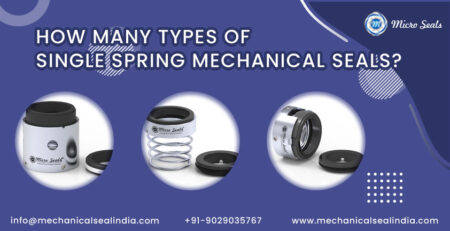
Single Coil Spring
Single coil designs use a large-diameter, heavy-duty spring.
They are highly resistant to clogging and corrosion, making them suitable for dirty, viscous, or slurry applications.
However, they usually require more axial space and do not provide perfectly uniform loading across the seal faces.
Multiple Springs
Multi-spring designs use several small springs distributed around the seal.
They provide more uniform face loading and allow a shorter axial working length.
Their main limitation is a higher risk of clogging when solids are present in the fluid.
Wave Springs
Wave springs are manufactured from flat wire and occupy only 30% to 50% of the axial space required by conventional coil springs.
A major advantage is that they do not generate torsional or twisting loads during compression. This reduces wear on secondary sealing elements such as O-rings.
Bellows Springs (Non-Pusher Seals)
Bellows seals may be manufactured from metal, rubber, or PTFE.
In metal bellows seals, the bellows performs two functions:
- it acts as the spring, and
- it also acts as the secondary seal.
Because there is no sliding O-ring, these designs eliminate the risk of secondary seal hang-up caused by deposits or solids.
Mechanical Seal Spring Materials for Different Environments
Spring material selection depends mainly on the chemical aggressiveness of the fluid and the operating temperature.
The most commonly used spring materials include:
316 stainless steel
Used as the standard material for general water services and mildly corrosive fluids.
Hastelloy C-276
Selected for highly corrosive environments, including strong acids and oxidising chemicals.
Inconel 718
A high-nickel alloy designed for very high temperatures, typically above 700°F (370°C). It is widely used in refinery and hot-oil services.
Alloy 20
Chosen specifically for its excellent resistance to sulphuric acid.
17-7 PH stainless steel
Frequently used for wave springs because of its high fatigue resistance and mechanical strength.
Correct material selection significantly improves spring life and overall seal reliability.
Mechanical Seal Spring Maintenance and Failure Causes
Common Spring-Related Failure Modes
Clogging or packing
In multi-spring designs, solids can accumulate between the springs and restrict their movement. This prevents proper face tracking and leads to leakage.
Centrifugal unwinding
In rotating designs operating at high speeds, a single coil spring may expand radially due to centrifugal force. This reduces axial spring load and may cause mechanical interference.
Pitting corrosion
Chemical attack can create surface pits on the spring wire. These pits act as stress concentration points and eventually lead to fatigue failure.
Hang-up in pusher seals
In pusher-type seals, the dynamic O-ring may stick to the shaft or sleeve due to contamination or product build-up. When this happens, the spring cannot maintain face contact.
Recommended Maintenance Procedures
Free length verification
The unloaded spring length should be measured to confirm that the spring has not taken a permanent set due to excessive temperature or over-compression.
Spring rate testing
The stiffness coefficient of the spring should be verified to ensure the spring still delivers the designed closing load.
Correct use of setting clips during installation
Setting clips ensure the spring is compressed to the correct working length. Incorrect setting can lead to premature wear, leakage, or face damage.
Conclusion
Recommended Maintenance Procedures
Free length verification
The unloaded spring length should be measured to confirm that the spring has not taken a permanent set due to excessive temperature or over-compression.
Spring rate testing
The stiffness coefficient of the spring should be verified to ensure the spring still delivers the designed closing load.
Correct use of setting clips during installation
Setting clips ensure the spring is compressed to the correct working length. Incorrect setting can lead to premature wear, leakage, or face damage.